Get in Touch

Your Trusted Manufacturer of Laptops & Tablets


WhatsApp Us Directly

+86 13923410269


Email Us

elanchen@adreamertech.com


Contact Adreamer

  • Name *

  • Email *

  • WhatsApp *

  • Message

  • Get a Free Quote & Custom Solution

  • Security Code
    Refresh the code
    Cancel
    Confirm

Get in Touch
Your Trusted Manufacturer of Laptops & Tablets
图片展示

OEM Laptop Customization Process Guide

Adreamer cara From China's leading laptop computer manufacturer
Time: 2026-04-17
A complete guide on how businesses can customize their own laptops. Covers the full process from requirements analysis, solution design, mold development, and small-batch pilot runs to mass production delivery. and government sectors to help you execute your custom laptop project efficiently.

From major North American retail chains to European edtech companies and Southeast Asian government digitalization projects, more organizations are moving beyond off‑the‑shelf products. Standard laptops, while convenient, often fail to meet deep industry needs: mismatched ports, insufficient battery life, missing pre‑installed software, inconsistent branding, and a lack of optimization for local voltage and climate.

Customized laptops are built to solve these pain points. They go far beyond a simple logo swap. True customization covers hardware configuration, BIOS firmware, system images, keyboard layouts, power adapters, and after‑sales support. A laptop tailored to local market requirements boosts employee productivity, lowers IT maintenance costs, strengthens brand identity, and meets strict compliance rules worldwide.

So, how do you customize laptops to fit your specific needs? Adreamer provides a practical guide covering the complete lifecycle from requirements definition to mass production, with real‑world cases in education, government, retail, and manufacturing.

1. Requirements Analysis

1.1 Define Target Markets and User Personas

The first step is not drawing blueprints but answering key questions:

  • Where is the target market? North America, Europe, Southeast Asia, the Middle East, or Latin America? Voltage (110V/220V), plug types (US/EU/UK/AU), and climate (humid/dry/dusty) affect design.
  • Who are the users? Students, corporate employees, government staff, field engineers, or retail associates? Their technical skill, working environment, and physical traits (e.g., handedness, finger size) matter.
  • What are the core usage scenarios? Indoor offices, mobile travel, outdoor work, classrooms, warehouses, or factory floors? Scenarios dictate protection ratings, battery capacity, screen brightness, and other key parameters.

1.2 Create a Product Requirements Specification (PRS)

Before contacting an ODM/OEM, prepare a detailed PRS covering at least:

CategoryParameters
ProcessorIntel Core / AMD Ryzen / Qualcomm Snapdragon (based on performance/power needs)
RAM & StorageCapacity (8/16/32/64GB), type (DDR4/DDR5/LPDDR5), expandability; SSD capacity & interface (PCIe/SATA)
DisplaySize (11-16'), resolution (FHD/QHD/4K), brightness (250-1000 nits), touch, anti‑glare, low blue light certification
PortsUSB‑A count, USB‑C (Thunderbolt 4/DP Alt support), HDMI, RJ45, audio jack, SD reader, dedicated serial (e.g., RS232)
ConnectivityWi‑Fi 6E/7, Bluetooth 5.3, 4G/5G module (global band support), GPS
SecurityFingerprint reader, IR camera (Windows Hello), TPM 2.0, Kensington lock, tamper switch
Battery & PowerCapacity (Wh), runtime (hours), fast charging protocol, adapter plug type (US/EU/UK/AU, etc.)
Input DevicesKeyboard layout (US/UK/JP/DE, etc.), backlight, touchpad size, stylus support
OSWindows 11 Pro/Home, Windows 11 IoT Enterprise LTSC, Ubuntu Linux, ChromeOS, macOS (Apple‑authorized only)
Pre‑loaded SoftwareOffice suite, industry apps, security software, MDM client
Appearance & BrandingLogo silkscreen/laser engraving location, body color (Pantone), material (plastic/magnesium‑alloy/carbon fiber), packaging design
CertificationsCE (EU), FCC (US), UKCA (UK), ICES (Canada), RCM (Australia), CCC (China), VCCI (Japan), KC (Korea), RoHS, REACH, Energy Star, etc.
Environmental AdaptabilityOperating temperature (0~35°C or -10~50°C), humidity, dust/water resistance (IP rating), drop resistance (MIL-STD-810H)

1.3 Determine MOQ and Budget

MOQ directly affects cost and lead time:

  • White‑label (logo, boot animation, packaging only): MOQ starting from 500 units, lead time 4‑6 weeks.
  • Modified reference design (case color, ports, keyboard): MOQ starting from 1,000 units, lead time 8‑12 weeks.
  • Deep customization (new molds, motherboard changes, custom firmware): MOQ starting from 2,000‑5,000 units, lead time 14‑20 weeks.

2. Solution Design

2.1 Hardware Platform Selection

The ODM/OEM recommends core platforms based on needs:

  • High‑performance business: Intel Core Ultra 7/9 or AMD Ryzen 7/9 PRO.
  • Mainstream value: Intel Core i5/i7 or AMD Ryzen 5/7.
  • Low power, long battery life: Intel N‑series, AMD Ryzen 3, Qualcomm Snapdragon X Elite.
  • Industry‑specific: Rugged or embedded platforms for education, retail, healthcare.

Also decide on RAM type (SO‑DIMM slots or onboard LPDDR), storage (M.2 2280 or 2242, dual drives support), and wireless modules (Intel BE200, Qualcomm FastConnect, etc.).

2.2 Mechanical Design

Mechanical engineers create 3D models based on motherboard size, battery capacity, and thermal requirements. Key design points:

  • Thermal solution: Heat pipe count, fan size, vent placement, fanless passive cooling (for silent operation).
  • Port layout: Ergonomic – common ports (USB, audio) on sides, video output at rear.
  • Reinforcement: Magnesium alloy internal frame, corner bumpers, metal screen support (for mobile/outdoor use).
  • Dust/water protection: Silicone port covers, keyboard spill‑drain channels (for education/food service).

2.3 Software and Firmware Customization

BIOS/UEFI: Custom boot logo, default boot order, disable unnecessary devices (e.g., camera, Bluetooth), set admin password, configure PXE network boot.

OS image: Pre‑install OS (multi‑language support: English, French, German, Spanish, Arabic, etc.), integrate drivers, industry software, security patches; configure power plans, desktop wallpaper, browser bookmarks.

Recovery partition: One‑key restore for easy remote IT maintenance.

MDM integration: Preload Microsoft Intune, VMware Workspace ONE, SOTI, or other MDM clients for batch enrollment and policy deployment.

3. Tooling & Firmware Development

3.1 Mold Development (if new molds are required)

  • Lead time: 45‑60 days.
  • Cost: $8,000–$30,000 USD (depending on complexity).
  • Process: T1 trial → T2 modification → T3 finalization.
  • Cost saving: Use the factory’s existing reference molds and modify only the A‑cover (top lid) or C‑cover (keyboard deck) to save up to 80% of tooling costs.

3.2 Firmware Development & Debugging

  • BIOS adaptation: Low‑level debugging for new hardware platforms (e.g., Intel Meteor Lake, AMD Phoenix); enable TPM 2.0, Secure Boot.
  • Driver integration: Ensure all peripherals (touchpad, fingerprint sensor, camera, 4G/5G module) work flawlessly under Windows/Linux.
  • Stability testing: 72‑hour stress tests (AIDA64, MemTest86, Prime95) – no blue screens, no crashes.

4. Small‑Batch Pilot Run

4.1 Pilot Run Process

A small batch (typically 500 units) is the best time to catch issues.

  • SMT placement verification: Check motherboard yield – BGA soldering, 0201 component placement.
  • Assembly line validation: Test assembly process, housing gaps, button feel, screen flatness.
  • Functional test: 100% test all ports (USB, HDMI, audio, Ethernet), camera, microphone, Wi‑Fi/Bluetooth, battery charge/discharge.
  • Burn‑in test: 48‑hour high‑temperature (50°C) aging to expose early failures.

4.2 User Trial and Feedback

Give pilot units to real users in the target market (e.g., school teachers, corporate employees, warehouse workers) for 1‑2 weeks. Common feedback includes keyboard layout discomfort, overly sensitive touchpad, shorter battery life than expected, and peripheral compatibility issues.

4.3 Rework and Golden Sample

Modify the design based on feedback (e.g., adjust touchpad driver, optimize power policy). Once confirmed, seal a “golden sample” as the acceptance standard for mass production.
5. Mass Production & Delivery

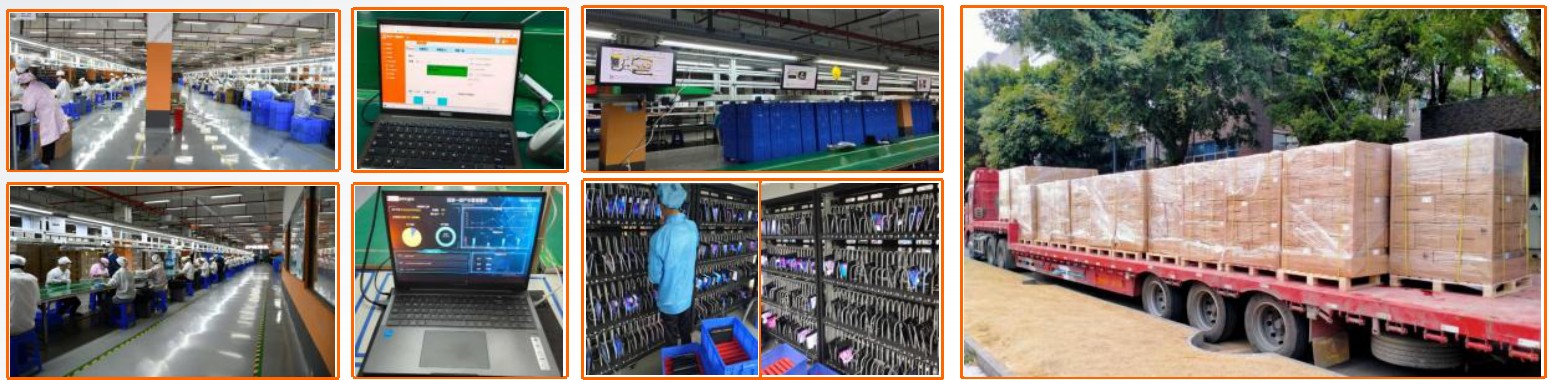
5.1 Production Preparation

  • Material procurement: Lock long‑lead‑time components (CPU, DRAM chips, screen, battery) with supply agreements.
  • Production line scheduling: Dedicated line to ensure on‑time delivery.
  • Quality gates: Set AQL sampling standards (e.g., critical defects: accept 0, reject 1; major defects: accept 1, reject 2).

5.2 Production Process

  • SMT: Automated placement of components on motherboards, with AOI and X‑ray inspection.
  • Assembly: Screen, battery, keyboard, housing, antenna assembly.
  • Burn‑in: 100% of units undergo 24‑48 hour aging.
  • Full functional check: Test ports, network, camera, buttons, battery on each unit.
  • Cosmetic inspection: Check scratches, color difference, silkscreen, logo placement under standard lighting.

5.3 Packaging & Logistics

  • Custom packaging: Retail box with client logo, multi‑language manual, warranty card.
  • Accessories: Power adapter (with local plug), power cord (meeting local safety standards), optional mouse.
  • Shipping: Factory direct to global warehouses. Recommend shipping insurance and assist with customs clearance.

5.4 After‑Sales Service

  • Warranty: 1‑3 years for the whole unit, 1 year for battery (extendable to 3 years).
  • Spare parts: Continue to supply key parts (motherboard, screen, battery) for at least 5 years after end‑of‑life.
  • Global service: Choose a third‑party repair network partnered with the factory, or use factory mail‑in repair.

6. Real‑World Laptop Customization Cases

Case 1: European EdTech – Digital Classroom Laptops

  • Need: 3,000 primary/secondary schools in France, Germany, Spain needed learning laptops. 11.6″ anti‑glare low‑blue‑light screen, silicone protective case, multi‑language Windows 11 Education, Google Classroom & Microsoft Teams integration, parental control software.
  • Solution: Intel N100, 8GB DDR4, 128GB SSD, 11.6″ IPS (250 nits). Keyboard layouts: French AZERTY, German QWERTZ, Spanish QWERTY. Custom OS image – auto login to student account, app store disabled. Certifications: CE, RoHS, Energy Star.
  • Delivery: 5,000 units, 12 weeks.
  • Result: Device failure rate <1.5%; parents reported effective parental controls.

Case 2: North American Retail Chain – POS & Inventory Management Terminals

  • Need: 800‑store convenience chain needed 2,000 laptops for checkout and inventory. Requirements: magnetic stripe reader, convertible touchscreen (tent mode), IP54 spill resistance, 24/7 standby.
  • Solution: AMD Ryzen 5 7530U, 16GB RAM, 512GB SSD, 13.3″ touchscreen. Added magnetic stripe reader module (USB direct‑connect), dual USB‑A, RJ45. Pre‑installed retail POS system, irrelevant apps disabled. Certifications: FCC, UL, Energy Star.
  • Delivery: 1,800 units, 14 weeks.
  • Result: Staff efficiency +25%, return rate only 0.8%.

Case 3: Southeast Asian Government – Rural Digital Office

  • Need: 3,000 laptops for grassroots government offices. Low power, long battery, dust resistance, 4G LTE support, pre‑loaded local government system.
  • Solution: Intel Core i3‑N305, 8GB RAM, 256GB SSD, 14″ matte screen. Integrated 4G module (local bands), dual SIM slots. 45Wh battery, PD fast charging, UK plug. Ubuntu Linux + local government apps, LibreOffice pre‑installed. Certifications: CE, RCM.
  • Delivery: 3,000 units, 16 weeks.
  • Result: Rural officials reported stable network connection and all‑day battery life.

7. Sourcing Pitfalls to Avoid When Customizing Laptops

Pitfall 1 – Ignoring international certifications. Different markets mandate different certifications. No CE mark means no EU entry; no FCC means no US sales. Contractually require the factory to support certification and provide certificate copies.

Pitfall 2 – Mismatched power adapters. Plug type (US/EU/UK/AU) and voltage (110V/220V) must match the target market. Otherwise customers cannot charge, leading to massive returns.

Pitfall 3 – Wrong keyboard layout. US layout for English‑speaking countries, UK layout (different Enter key) for the UK, AZERTY for France, QWERTZ for Germany. Verify the local standard before customization.

Pitfall 4 – Missing language and localization. OS language, manuals, BIOS interface, even boot sounds should be localized. Otherwise poor user experience and high support costs.

Pitfall 5 – Underestimating logistics and tariffs. Sea freight from China to the US/EU takes 30‑45 days; air freight is expensive. Also understand import duties, VAT, and environmental fees (e.g., WEEE) in the destination country. Consider DDP (Delivered Duty Paid) terms with the factory.

8. How to Choose a Global Customization Partner

Evaluate a factory’s global customization capabilities using these criteria:

  • Multi‑language support: Can they provide system images in English, French, Spanish, Arabic, etc.?
  • Certification experience: Have they helped clients pass CE, FCC, UKCA, KC, and other certifications?
  • Global logistics network: Do they have stable freight forwarders supporting DDP to the US, Europe, and Southeast Asia?
  • Flexible manufacturing: Can they accept small batches starting from 500 units?
  • After‑sales system: Do they have authorized repair centers in major markets or offer mail‑in repair?

If you are planning to customize a batch of laptops, start with a detailed Product Requirements Specification and find an experienced laptop manufacturing partner.


Click:
Like | 0
share
OEM Laptop Customization Process Guide
A complete guide on how businesses can customize their own laptops. Covers the full process from requirements analysis, solution design, mold development, and small-batch pilot runs to mass production delivery. and government sectors to help you execute your custom laptop project efficiently.
Long by picture save/share

  Industry-Specific Solutions

   Latest Blog

Adreamer

© 2012-2025 Copyright Shenzhen Adreamer Technology Co., Ltd.粤ICP备18115621号-2

Contact Adreamer Today for Your Custom Solution & Quote!

  • Email *

Grab the Promo Deal

Security Code
Refresh the code
Cancel
Confirm

Map

手机: +86 13922841306

图片展示

© 2012-2025 Copyright Shenzhen Adreamer Technology Co., Ltd.粤ICP备18115621号-2

添加微信好友,详细了解产品
使用企业微信
“扫一扫”加入群聊
复制成功
添加微信好友,详细了解产品
我知道了