Get in Touch

Your Trusted Manufacturer of Laptops & Tablets


WhatsApp Us Directly

+86 13923410269


Email Us

elanchen@adreamertech.com


Contact Adreamer

  • Name *

  • Email *

  • WhatsApp *

  • Message

  • Get a Free Quote & Custom Solution

  • Security Code
    Refresh the code
    Cancel
    Confirm

Get in Touch
Your Trusted Manufacturer of Laptops & Tablets

图片展示

OEM vs ODM for Tablets what’s the difference

Adreamer-Elan From China's leading OEM tablet manufacturer
Time: 2025-12-18
For tablet startups, understanding the difference between OEM and ODM is crucial. Adreamer breaks down the key distinctions and provides a decision-making framework to help you choose the right manufacturing model based on your needs and budget.

When an ambitious startup founder plans to launch their own brand of tablet, they often face a critical first choice in the supply chain: Should they choose OEM or ODM? These two seemingly similar terms represent fundamentally different models of product development, resource investment, and commercial risk. Choosing the correct path helps efficiently integrate resources, accelerate time-to-market, and seize opportunities. Choosing incorrectly can lead to struggles caused by high R&D costs or being trapped in a market of indistinguishable products. Therefore, clearly understanding the essential difference between OEM and ODM is a key first step toward success for any startup.

1. The Core Difference: OEM vs. ODM for Tablet Customization

OEM – Contract Manufacturing

Imagine you are a restaurateur with a passion for culinary perfection. You personally develop a secret sauce recipe, design the exquisite plating for each dish, and write a detailed cooking manual. You then find a fully equipped, hygienic commercial kitchen and ask them to produce these dishes in bulk, strictly following your recipe and process. Finally, you sell these dishes under your restaurant's brand. Here, you are the absolute product creator; the kitchen is merely an extension of your capabilities.

Applied to tablets: You the brand complete or outsource the design of the product's appearance, structure, motherboard layout, circuitry, and even some low-level drivers and user interface. You then provide this complete set of design documents—including schematics, 3D structural drawings, and the Bill of Materials BOM—to a manufacturing factory. The factory's task is to procure the components you specify and produce and assemble the units strictly according to your drawings and process requirements. The finished product bears your logo. This is the classic OEM model. The relationship between Apple and Foxconn is the prime example.

ODM – Design and Manufacturing

Now, change the scenario. You also want to open a restaurant but do not want to develop recipes from scratch. You visit a large food company whose showroom displays dozens of mature restaurant solution packages: Package A features Southeast Asian flavors, Package B is fine Western cuisine, Package C is fusion Chinese. Each package includes a complete menu, standardized ingredient kits, and cooking methods. You choose Package B and request minor tweaks: make the steak sauce milder and imprint your logo on the plate. The food company makes these adjustments and produces the finished dishes for you, which you then sell directly under your own brand.
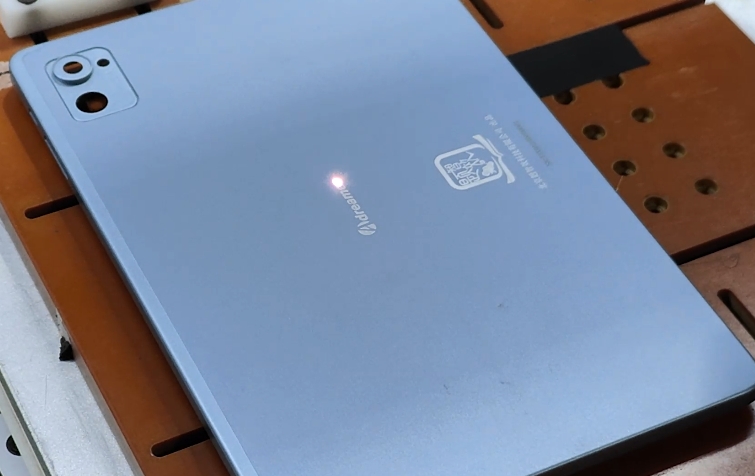
Applied to tablets: The brand approach a design manufacturer that offers mature product solutions. They typically have a catalog of public mold designs—various tablet models that have already completed research and development, testing, and obtained relevant certifications. You select a base model closest to your needs and perform some customizations on it. This might involve changing the case color, adjusting the RAM and storage configuration, displaying your logo on the boot screen, or requesting pre-installation of your proprietary application. The core industrial design, motherboard architecture, and software system are all provided by the ODM manufacturer. This is the ODM model. Most white-label tablets, carrier-customized tablets, and industry-specific tablets on the market use this approach.

One-Sentence Summary: OEM is I design, you manufacture. ODM is You design and manufacture, I brand and tweak. The key choice depends on whether you possess the design or the brand vision and market requirements.
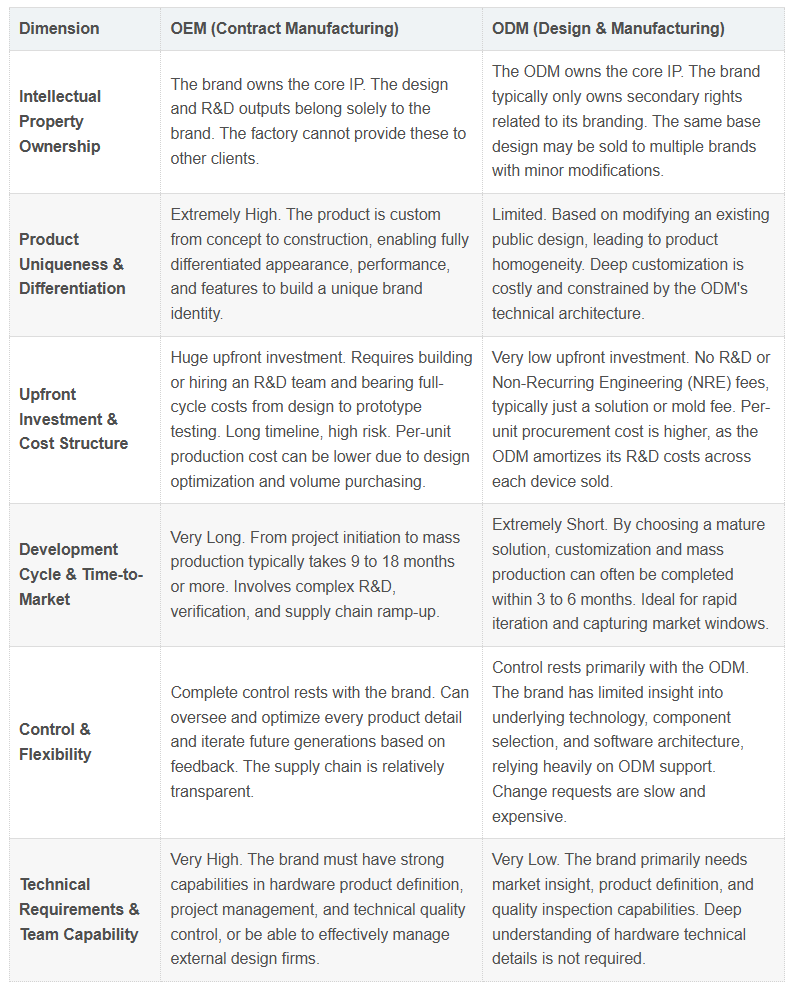
2. A Systematic Comparison: Six Key Dimensions of OEM vs ODM

3. Core Needs and Dilemmas of a Startup

For a startup, choosing between OEM and ODM is not merely a technical decision but a strategic one concerning survival and growth. A startup must first clarify its own actual situation:

  • Extreme Capital Sensitivity: Limited startup funding means every dollar must be spent wisely. The company cannot afford to lose millions on failed R&D.
  • Time is Critical: Market windows are fleeting. The product must be launched to validate demand as quickly as possible; being slow can be fatal.
  • Lack of Experience: The team may be strong in software, content, or business models but lacks experience taking a hardware product from zero to one. It is often unfamiliar with supply chain management, quality control, and certifications.
  • Desire for Differentiation: The founders understand that undifferentiated products stand little chance in a competitive market and hope to build brand recognition and technical barriers.
  • Low Risk Tolerance: One major product failure or inventory overstock can severely damage or outright end the company.

4. Decision Framework: When to Choose Each Model

There is no universally correct answer, only the choice best suited to the current stage. Please refer to the following framework.

Scenario 1: ODM is the Recommended Starting Point

If your company matches most of the characteristics below, ODM is likely your only logical starting point:
  • Validation-First Venture: Your core innovation lies in software, a service, or a specific industry solution; hardware is merely the vehicle for your content. e.g., an educational content company needs a learning tablet with a locked-down interface; a restaurant digitization company needs a tablet with an integrated ordering system.

  • Very Limited Budget: Cannot allocate funds at the level of hundreds of thousands of dollars for hardware R&D.
  • Pursuing Maximum Speed: You need to launch before the next key sales season back-to-school, holidays or a crucial funding milestone.
  • Testing a Niche Market: Uncertain about market size; need to test the waters with small batches and low cost.
  • Lacks a Hardware Team: No internal team members with hardware expertise, and you do not wish to complicate early-stage hiring or manage external design teams.

ODM Strategy Tips:

  • Focus on Micro-Innovation: Even when using a public design, create unique selling points through software user experience, content integration, aesthetic details like printing, color, or accessories.
  • Vet ODM Partners Deeply: Assess their past projects, R&D capability, quality control systems, and willingness to collaborate. Prioritize partners with experience in similar products who are willing to work closely on hardware-software integration.
  • Clarify Intellectual Property in the Contract: Explicitly define the ownership of customized elements and prohibit the ODM from providing your specific customized solution directly to your competitors.

Scenario 2: Consider the OEM Model

If your company meets the following conditions, you can consider the OEM path to build long-term competitive barriers:

  • Hardware Innovation is Core: Your business model relies on unique hardware design e.g., a special form factor like rugged, foldable, or ultra-long battery; integrated special sensors; or a novel interaction method.
  • Sufficient Funding is Secured: You have enough capital to support at least 18 months of R&D and supply chain cycles and can withstand potential risks.
  • Has an Experienced Hardware Team: The founder or core team has a background in the hardware industry with experience in successful product R&D and supply chain management.
  • Targeting a Premium or Niche Market: Your target customers are less sensitive to price but have high demands for quality, design, and uniqueness—requirements that public designs cannot meet.
  • Has a Clear Long-Term Product Roadmap: You have a planned path for product iteration, and the technology and intellectual property accumulated through the OEM model will pave the way for future products.

OEM Strategy Tips for Startups:

  • Consider a Lightweight OEM Approach: You don't need to fully self-develop like a large corporation. You can hire professional industrial design firms and solution design houses to handle the core design, then hand over production to an OEM factory. This is more flexible than building a full internal team.
  • Invest in Phases: Start with a Minimum Viable Product focused on one or two core innovations, simplifying other features to control initial R&D cost and complexity.
  • Partner with Key Experts: Establish a deep relationship with an OEM or design house experienced in working with startups. They can provide invaluable guidance on engineering execution, cost control, and mass production.

Hybrid Strategy: Start with ODM, Evolve to OEM

This is often the ideal growth path for most hardware startups.
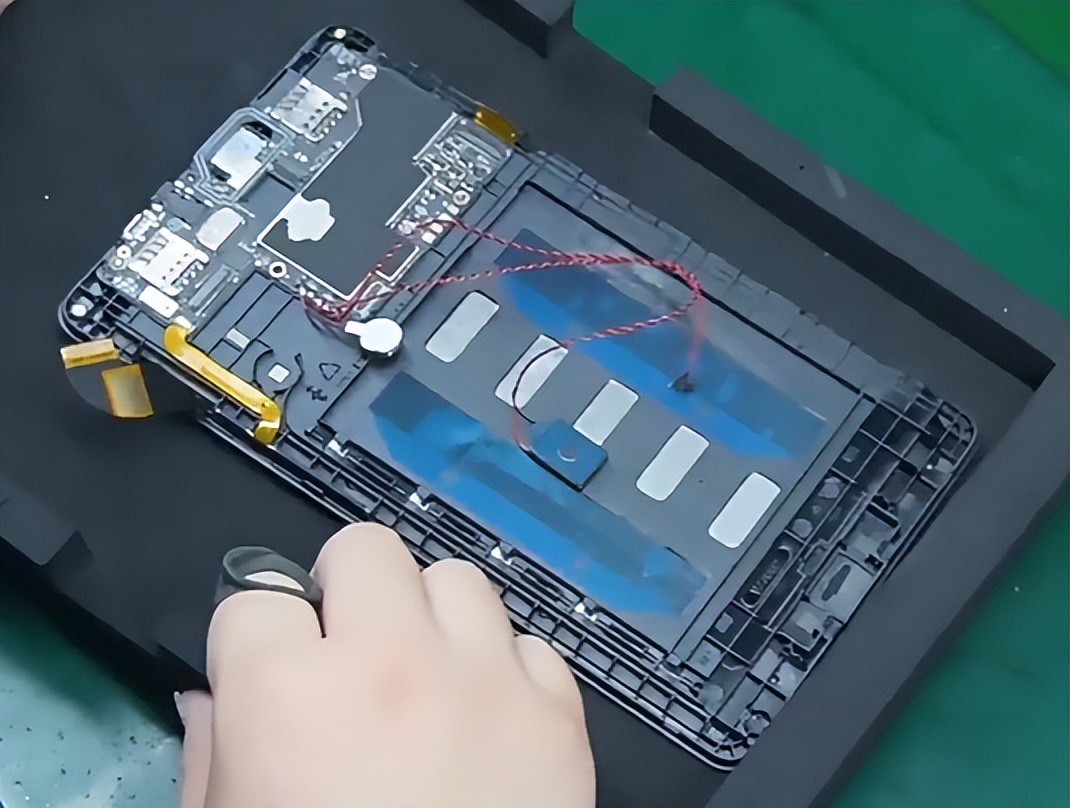
  • Phase 1 From 0 to 1: Use the ODM model to quickly launch a first-generation product. This validates the market, establishes the brand, and gathers user feedback and initial capital. Simultaneously, use the ODM partnership to deeply learn the entire hardware product development and manufacturing process.
  • Phase 2 From 1 to N: Use the profits from the first generation or new funding to attempt Partial OEM for the second-generation product. For example, retain the ODM's proven motherboard solution but self-develop the external design, battery module, or key accessories to achieve important differentiation.

  • Phase 3 Building the Moat: Once the company is stable and scaling, gradually increase R&D investment into core modules like the motherboard or proprietary algorithms, eventually transitioning to a full OEM model to gain complete control over the product's core technology.

5. Key Negotiation Points and Risk Warnings

Regardless of the chosen model, negotiations with your partner are crucial.

With an ODM, Focus On:

  • Minimum Order Quantity -MOQ: Negotiate for the lowest possible MOQ to reduce inventory risk.
  • Customization Scope and Cost: Clearly define which modifications are included, which incur additional charges, and the pricing for those changes.
  • Software Updates and Maintenance: Ensure the ODM contractually commits to providing long-term system security patches and technical support.
  • Exclusivity Clause: Explore whether you can prohibit them from providing highly similar solutions to your direct competitors for a defined period.

With an OEM or Design House, Focus On:

  • Intellectual Property Ownership: It must be contractually stipulated in writing that all design outputs belong to you.
  • Project Pricing and Payment Milestones: Structure payments in phases tied to key deliverables like design completion, sample approval, and production readiness.
  • Bill of Materials BOM and Cost Transparency: Request visibility into the sourcing channels and costs of key components to facilitate future cost optimization and supply chain management.

Primary Risk Warnings:

  • ODM Primary Risks: Product homogenization competitors can launch nearly identical products quickly; Heavy supply chain dependency if the ODM has problems, you have limited recourse; A ceiling on innovation depth.
  • OEM Primary Risks: R&D failure; Cash flow disruption; Loss of control over project timelines.

6. Conclusion: How to Make the Choice

For a startup, choosing between OEM and ODM is fundamentally about finding the optimal balance between speed, cost, control, and uniqueness.

If your venture needs to launch quickly to capture market share, the ODM model will save significant development time and resources, enabling an efficient start. If your goal is to build a product with a unique competitive advantage and long-term brand value, the OEM model, despite its higher upfront investment and longer timeline, offers greater autonomy and potential for differentiation.

Experienced entrepreneurs rarely limit themselves to a single model. They often begin with ODM to rapidly validate the market, accumulate technical and supply chain knowledge during growth, and then strategically shift towards OEM when the time is right to gain control over core technologies. The key is to choose the path most aligned with your company's current resources, product vision, and market stage. Hardware entrepreneurship is challenging; success comes from pragmatic assessment and the flexibility to adapt your strategy along the way.


Click:
Like | 0
share
OEM vs ODM for Tablets what’s the difference
For tablet startups, understanding the difference between OEM and ODM is crucial. Adreamer breaks down the key distinctions and provides a decision-making framework to help you choose the right manufacturing model based on your needs and budget.
Long by picture save/share

  Industry-Specific Solutions

   Latest Blog

Adreamer

© 2012-2025 Copyright Shenzhen Adreamer Technology Co., Ltd.粤ICP备18115621号-2

Contact Adreamer Today for Your Custom Solution & Quote!

  • Email *

Grab the Promo Deal

Security Code
Refresh the code
Cancel
Confirm

Map

手机: +86 13922841306

图片展示

© 2012-2025 Copyright Shenzhen Adreamer Technology Co., Ltd.粤ICP备18115621号-2

添加微信好友,详细了解产品
使用企业微信
“扫一扫”加入群聊
复制成功
添加微信好友,详细了解产品
我知道了