
Get in Touch
Your Trusted Manufacturer of Laptops & Tablets
WhatsApp Us Directly
+86 13923410269
Email Us
Get in Touch
Your Trusted Manufacturer of Laptops & Tablets

Five years ago, launching your own laptop brand was incredibly difficult for a startup. Mold costs alone could run tens of thousands of dollars, minimum order quantities (MOQ) were in the thousands, and R&D investment often topped a million. But by 2026, the landscape has changed completely. Public molds are mature, solution providers are abundant, and flexible low‑volume production is common – you can start with as few as 500 units. Educational institutions, industry integrators, and even individual entrepreneurs now have the chance to launch their own notebook brand.
Lower barriers, however, don’t mean a smooth ride. From a product definition document to mass production, there are countless pitfalls: choosing the wrong factory, failing pilot runs, component substitutions, delivery delays. This article provides a complete roadmap, outlining the key actions and pitfalls at each stage. Whether you’re building an education laptop, a business notebook, or an industry‑specific device, the process applies.

Before contacting any OEM factory, fill out this table:
| Item | Your Answer |
|---|---|
| Core users | Students, corporate employees, government desk staff, or factory workers? |
| Usage scenarios | Classrooms, offices, outdoors, or production lines? |
| Core pain points | Long battery life? Rugged? Rich ports? Cost‑performance? |
| Competitor analysis | What products exist at your price point? Your differentiation? (e.g., same $400 price, but you offer an extra RJ45 port or pre‑loaded education software) |
This is your “constitution” when communicating with factories. Be as detailed as possible. Include at least:
Tip: Don’t jump straight to “full customization.” Using a public mold with just a logo change can save 80% of tooling costs. Validate the market first with a stock design.
| Type | Description | Lead Time | MOQ | Tooling Cost |
|---|---|---|---|---|
| Public mold (white‑label) | Factory has mature mold & board; you change logo, packaging, preload software | 2‑3 months | 100‑300 units | None or very low |
| Semi‑custom | Modify case color, add specific ports (e.g., serial), adjust battery capacity | 3‑4 months | 500‑1,000 units | $1,500‑4,000 (one‑time) |
| Full custom | New molds, motherboard layout changes, custom BIOS | 4‑6 months | 2,000+ units | $7,000‑21,000 |
Don’t just look at price. Score factories (total 100 points):
| Dimension | Weight | Evaluation Points |
|---|---|---|
| Qualifications & track record | 20% | ISO9001, mass production cases of similar laptops |
| R&D capability | 25% | ≥5 hardware engineers, ability to modify BIOS and create system images |
| Production & QC | 25% | ≥4 SMT lines, burn‑in room, lab, first‑pass yield ≥98% |
| Supply chain | 15% | Transparent sourcing for CPU, screen, battery; safety stock |
| Service | 15% | Supports small batches, fast response, spare parts commitment (5 years after EOL) |
Must do: Visit the factory. Inspect the burn‑in room, SMT workshop, incoming material warehouse, and randomly check work‑in‑progress units.
What’s included in NRE (Non‑recurring engineering) fees? How many free revisions?
Are mold costs separate or amortized into unit price? Will they be refunded after a certain volume?
Are RAM, SSD, screen brand‑specified? Extra cost for changing components?
Penalty for delayed delivery? (e.g., 0.3‑0.5% of order value per day)
The factory builds 2‑5 hand‑made prototypes. Don’t focus on aesthetics yet. Test:
Functionality: Do all ports work? Wi‑Fi/Bluetooth stable? Camera and microphone OK?
Thermals & noise: Run at full load for 30 minutes – CPU temperature? Fan noise acceptable?
Battery life: Simulate real use (50% brightness, Wi‑Fi on, video playback).
Deliverables: EVT units + preliminary test report.
Common failures: Insufficient cooling causing throttling, poor antenna placement leading to weak signal, battery life far below spec. Fix these before mold development.
Skip if using public mold. Process: mold design (2 weeks) → T1 trial → modification → T2 trial → T3 finalization. Total 6‑10 weeks.
Critical: After T1 trial, assemble a real unit. Check screw holes, button feel, screen fit. Fix issues as early as possible.
Use production‑ready molds and materials to assemble 10‑20 units. Perform more comprehensive tests:
Compatibility: Common USB drives, external monitors, printers, projectors – all recognized?
Stress test: 48‑hour continuous run – record crashes, blue screens, reboots.
Drop test (if required): From 1 meter – check structural damage.
Sign‑off: After DVT passes, seal a “golden sample” as the acceptance standard for mass production.
Goal: Produce 100‑500 units on the real production line.

Why this step is essential: Many issues only appear during mass production – difficult assembly at a certain station, batch‑to‑batch color variation on screens, battery swelling in the burn‑in room. The pilot run exposes these “production‑specific” problems.
What to check:
Assembly first‑pass yield (should exceed 95%)
All functional test stations covering every feature
Paint color difference within tolerance
Packaging materials (retail box, manual, adapter) compliant and correct
Send samples to third‑party labs based on target markets:
China: CCC, SRRC (wireless), energy label
EU: CE, RoHS, REACH
US: FCC, UL (optional)
Other: UKCA, PSE, KC, etc.
Note: Reputable factories offer pre‑testing services to fix issues early, greatly increasing first‑pass approval rates and saving 2‑3 months of rework time.
Give pilot units to actual users (e.g., a few school classes, several company departments) for 1‑2 weeks. Collect feedback. You may discover: keyboard too stiff, a certain key unresponsive, screen glare at certain angles – things lab tests won’t catch.
Set AQL sampling standards, for example:
Critical defects (no power, electric leakage, cracked screen): AQL 0 (zero tolerance)
Major defects (stuck key, Wi‑Fi failure): AQL 1.5
Minor defects (slight scratch, crooked label): AQL 4.0
Tip: Send a QC representative to the factory or hire a third‑party inspector to randomly test units before shipment.
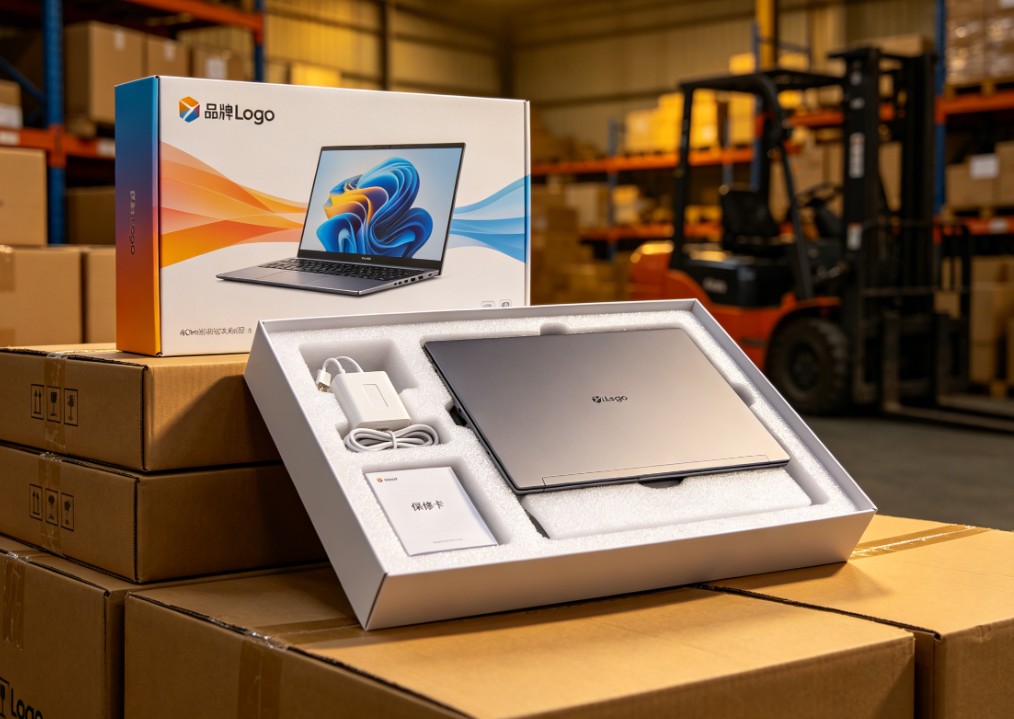
Confirm brand information on retail box, manual, and warranty card.
Check that power adapter plugs match destination country (US, EU, UK, etc.).
Use door‑to‑door shipping and purchase insurance (especially for air freight).
Contractually agree with the factory:
Warranty: 3 years for the whole unit, 1 year for battery (extendable)
Spare parts supply: Continue to supply motherboards, screens, batteries for at least 3 years after EOL
Repair turnaround: Ship repaired unit back within 7 business days of receiving the faulty unit
| Stage | Key Milestone | Completion Sign‑off |
|---|---|---|
| Requirements definition | Deliver PRS | Signed by both parties |
| Factory selection | Factory audit score ≥85, sign NDA | Quotation & initial schedule confirmed |
| Solution selection | Decide public / semi / full custom | Prototype timeline and cost confirmed |
| Prototype development | EVT test, DVT sign‑off | Test reports, golden sample sealed |
| Mold development | T1/T2/T3 trial completed | Mold acceptance report |
| Pilot run (PVT) | 100‑500 units built, user trial | FPY ≥95%, user feedback closed |
| Certification | Obtain CCC, CE, FCC, etc. | Certificate copies + test reports |
| Mass production | First order produced, sampling pass | Shipment, customer receipt signed |
| After‑sales | Spare parts pool, tech support training | After‑sales agreement signed |
Starting a laptop brand from scratch is both hard and easy. Hard because you must personally oversee every detail – from screw specifications to packaging material. Easy because today’s mature OEM ecosystem means you don’t need to build your own factory.
Choosing a factory that communicates well and is willing to grow with you through small‑batch trials is more important than picking the biggest manufacturer. Start today – put your laptop ideas into a specification sheet, and then take action.
What niche would you target if you were to launch your own laptop brand? Share your thoughts in the comments!
Industry-Specific Solutions
Latest Blog

Edge AI Box vs Cloud Server:Which Is Cheaper Long-Term?
A detailed TCO comparison of edge AI boxes and cloud servers. Covers hardware, bandwidth, power, and O&M costs, with break-even analysis and a decision checklist.
What AI Mini PC Do You Need for Private Local LLM Deployment?
Learn what AI mini PC specs you need for private deployment of local LLMs: memory, NPU, storage, offline capability, and configuration recommendations for 7B–70B models.

How to Choose an Edge Computing Box Manufacturer: ODM/OEM Guide
Learn how to evaluate edge computing box manufacturers. Compare source factories, ODM/OEM models, MOQ, certifications, and customization to find the right partner.
How to Choose an AI Mini PC in 2026: NPU & Memory Buying Guide
A practical guide to choosing an AI mini PC in 2026. Learn how to match NPU TOPS, memory capacity, and bandwidth to your workload, avoid common pitfalls, and pick the right configuration.
Adreamer

© 2012-2025 Copyright Shenzhen Adreamer Technology Co., Ltd.粤ICP备18115621号-2
Contact Adreamer Today for Your Custom Solution & Quote!
© 2012-2025 Copyright Shenzhen Adreamer Technology Co., Ltd.粤ICP备18115621号-2